
|
Roland MV-Series Format Information |
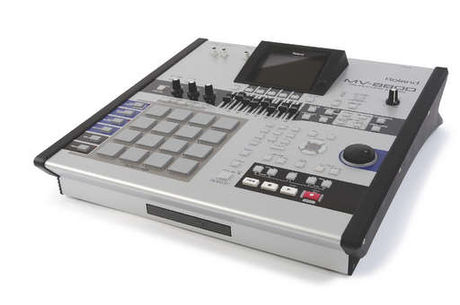
History The MV-8000 was designed to be a serious competitor to the Akai MPC-4000, in the new class of physically HUGE drum machines. It seems both companies seemed impressed to allow the user to compose complete songs on the unit, and that is why the Instrument/Program parts of the design were improved to not only allow pad-based drum programming, but chromatic MIDI instruments (piano, synth, etc.).
Then Roland released the MV8000 (as said before to compete with the Akai MPC4000) but let's consider the Fantom first, which was released about 1-2 years after the MV8000 (2003). Gone was the S700 sampling engine, but the XV Patch structure remained, with Roland completely redesigning access to Samples, which was via a new structure called Multisamples. This was a step backwards since Partials held their own Envelope/LFO/Modulator programming PLUS had their own 4 Zones, arranged horizontally. While the Fantom just had maximum 4 Multisamples on top of each other, and the samples no longer had their own tuning, panning, volume, etc. Now, let's go back to the MV8000. The engineers that designed it actually had a better idea how to do full Chromatic instruments. Although the MV8000 can only handle one Patch at a time, that Patch uses new redesigned Partials that referenced Samples, and it retained each Sample having it's own set of volumes, tunings, and pannings. Too good this was presented in the MV8000; too bad that structure style met it's end with the MV8000. The MV-8000 was followed up with the MV-8800, which added a couple of features like Phrases, but they had little to do with the sampling structure which concerns us here. Since the two instruments were so similar, we'll just refer to the two as MV8000. The MV8000 was BIG, sporting an internal notebook 30GB HDD and a notebook-style CD-ROM Drive. You could also hook it up to a computer via USB and the computer would see the internal drives an allow full file transfer. And even cooler, Roland stayed with their tradition of onboard monitor support, so an optional VGA card allowed a better interface to the unit, even though the onboard screen was pretty big. The MV has 6 banks of 16 pads each. Each pad is fixed to the MIDI note assigned to it, starting with A0 on Pad Bank 1 on the lower left. So that makes 96 notes - A0 - A7. Here's an amazing stat: the MV8000 could be upgraded with up to 512mb of memory! So it's samples could be huge. Of course it would take awhile to load the MV0 associated with it, but you could. And these days that only costs $15! That's a huge upgrade from the 32mb Roland S700-Series. Synthesis and File Structure As mentioned above, each Pad can have it's own Partial, and you can create up to 96 Partials, so each Pad has it's own 4 Zones (a Zone is a sample reference) with each Zone having its own volume, panning, and tuning. Each Partial has it's own set of Envelopes and LFO's and Modulators. But a Pad and a Partial are different things; you can have just one Partial and apply that one Partial to every Pad, and that Pad will play the Sample according to it's MIDI note (thus Chromatic) if the tracking is not turned OFF. So Roland had a neat way of addressing the Pad and the Chromatic paradigms. |
|
Translating and Building MV-Series Kits An .MV0 file holds just one Instrument, and that Instrument is plenty able to handle whatever size you throw at it (max 512mb). The Samples are written into the .MV0 file so there are no seperated WAVE files or anything else. Once you are done creating your MV0 file, just move it to your MV via USB cable or USB drive, copying it to the internal 30GB HDD. Then load it onto the MV itself. |
Translating Out of Roland MV Format The Instrument Unit on a .MV0 is the MV0 file itself. It only contains one Patch, and that's the Instrument Unit. So converting it will result in just one Instrument in the destination format. The Samples are within the MV0 and will be extracted and converted to whatever the destination format requires. |